







When Coat Season Changes the Way a Watch Wears
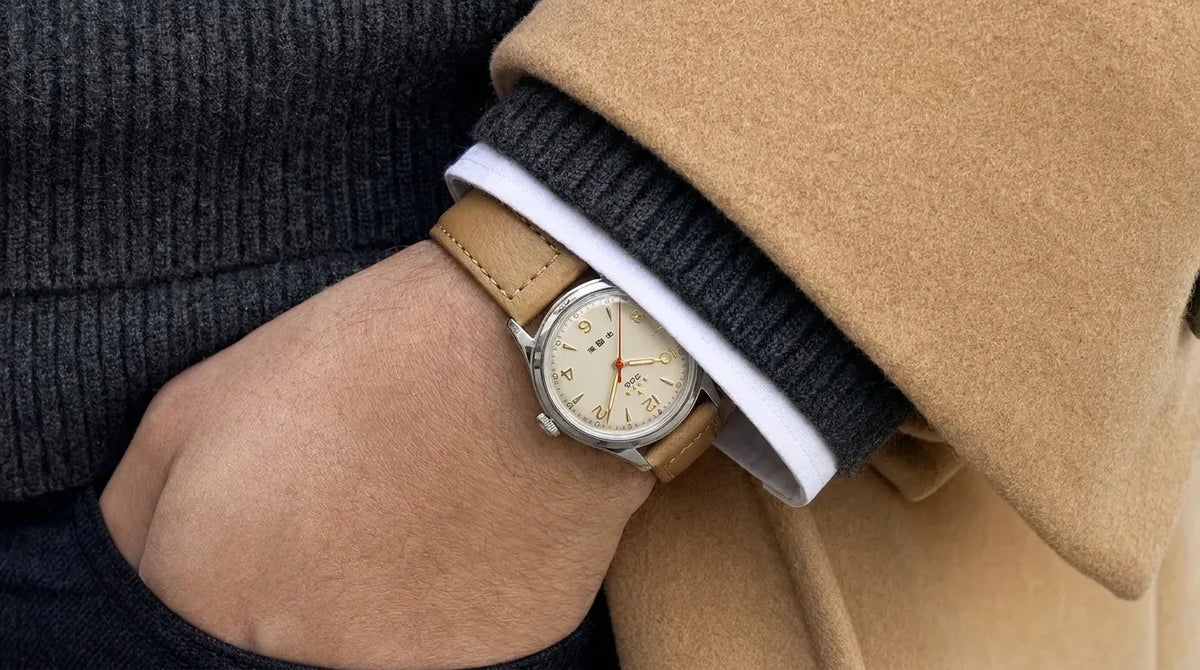
A timepiece that feels effortless against a bare wrist in July encounters a very different environment once temperatures drop. Between late autumn and early spring, a watch no longer sits in open air; instead, it negotiates shirt cuffs, ribbed knitwear, and structured overcoat sleeves. Evaluating watch case thickness under a winter coat cuff requires looking beyond a single caliper measurement. While total vertical height sets a baseline, how comfortably a watch moves beneath heavy tailoring depends on case geometry, lug span, movement architecture, and the way a strap or bracelet settles around a cold wrist.

Why Watch Case Thickness Under a Winter Coat Cuff Only Tells Half the Story
Published vertical height measures the distance between the bottom of the caseback and the apex of the crystal, yet sleeves never meet a watch along a strictly vertical plane. As the arm extends to reach into a coat pocket or grasp a briefcase handle, fabric approaches the watch at an angle. Here, bezel geometry and crystal profile determine whether a sleeve glides over the case or stacks awkwardly behind it.
A smooth, sloped bezel acts as an inclined ramp, guiding crisp cotton shirting upward across a flat synthetic sapphire crystal. By contrast, a textured or fluted bezel introduces three-dimensional facets that catch light and bring visual depth to heavier cold-weather textures, though it pairs more naturally with relaxed sleeve openings than tightly buttoned formal cuffs.
Horizontal footprint matters just as much. Two watches with identical vertical measurements can behave differently depending on their lug-to-lug span and wrist curvature. Compact, downturned lugs keep the watch head centered over the radius and ulna. When lugs project too far across a rounder wrist, the case can rock slightly, creating an edge that catches satin or cupro coat linings.
Similarly, sleeve construction dictates how much room a watch actually has:
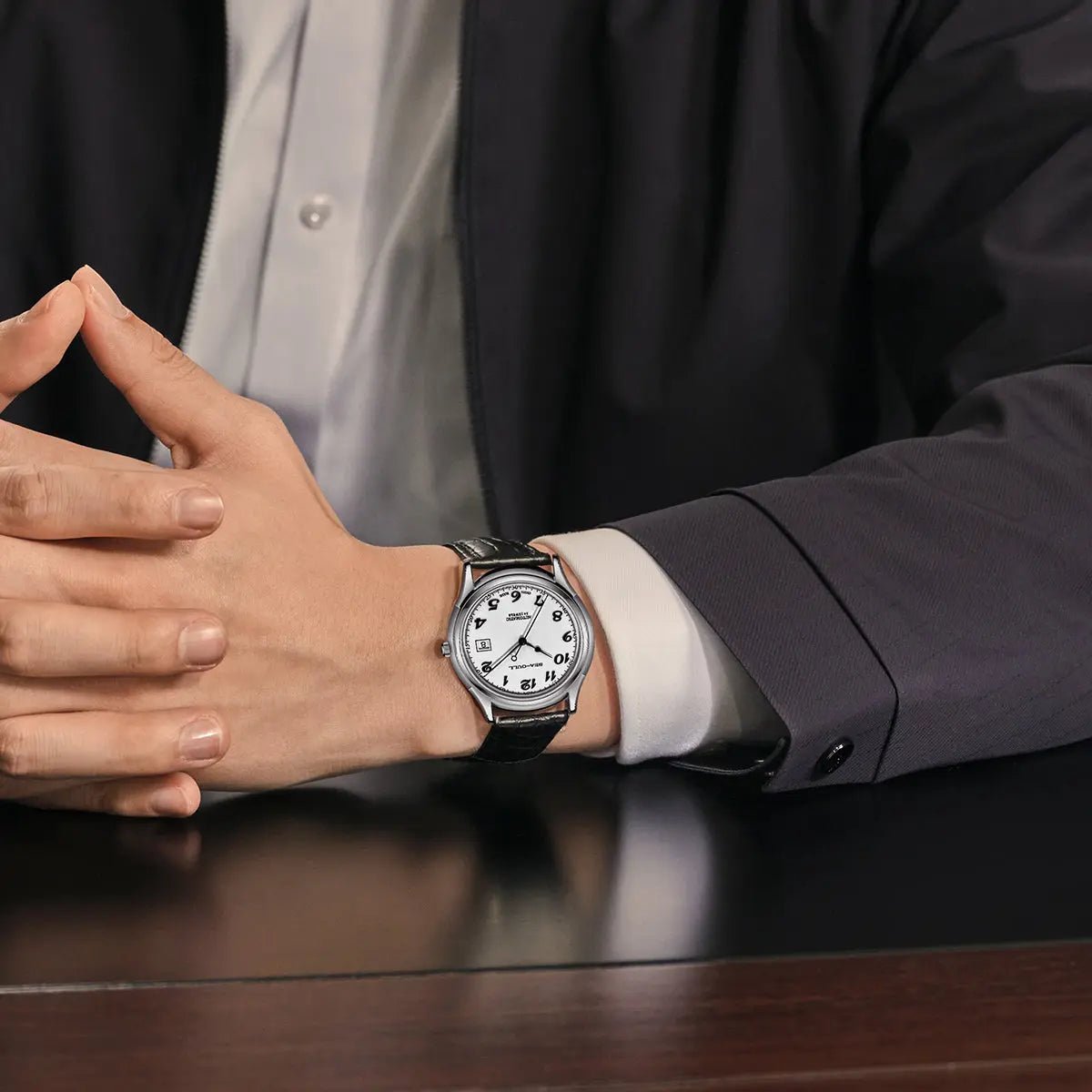
- French Cuffs: Folding the fabric back over itself doubles the layer of cotton and interlining, forming a rigid cylinder anchored by cufflinks that favors profiles around 7 mm to 10 mm.
- Barrel Cuffs: A single layer of buttoned shirting offers greater flexibility, typically accommodating cases between 9 mm and 11 mm.
- Ribbed Knitwear and Overcoats: Elastic sweater ribbing stretches over mid-profile cases up to 12.5 mm, while structured wool coat sleeves provide generous clearance so long as the transition between the shirt cuff and watch flank remains smooth.
How Movement Architecture Shapes Watch Case Thickness Under a Winter Coat Cuff
The silhouette of any wristwatch begins from the inside out. Dial clearances, hand stacks, crystals, and gaskets all add height, but the internal caliber establishes the foundational floor. Comparing quartz, manual-wind mechanical, and automatic mechanical architectures highlights the practical trade-offs each brings to a cold-weather wardrobe.
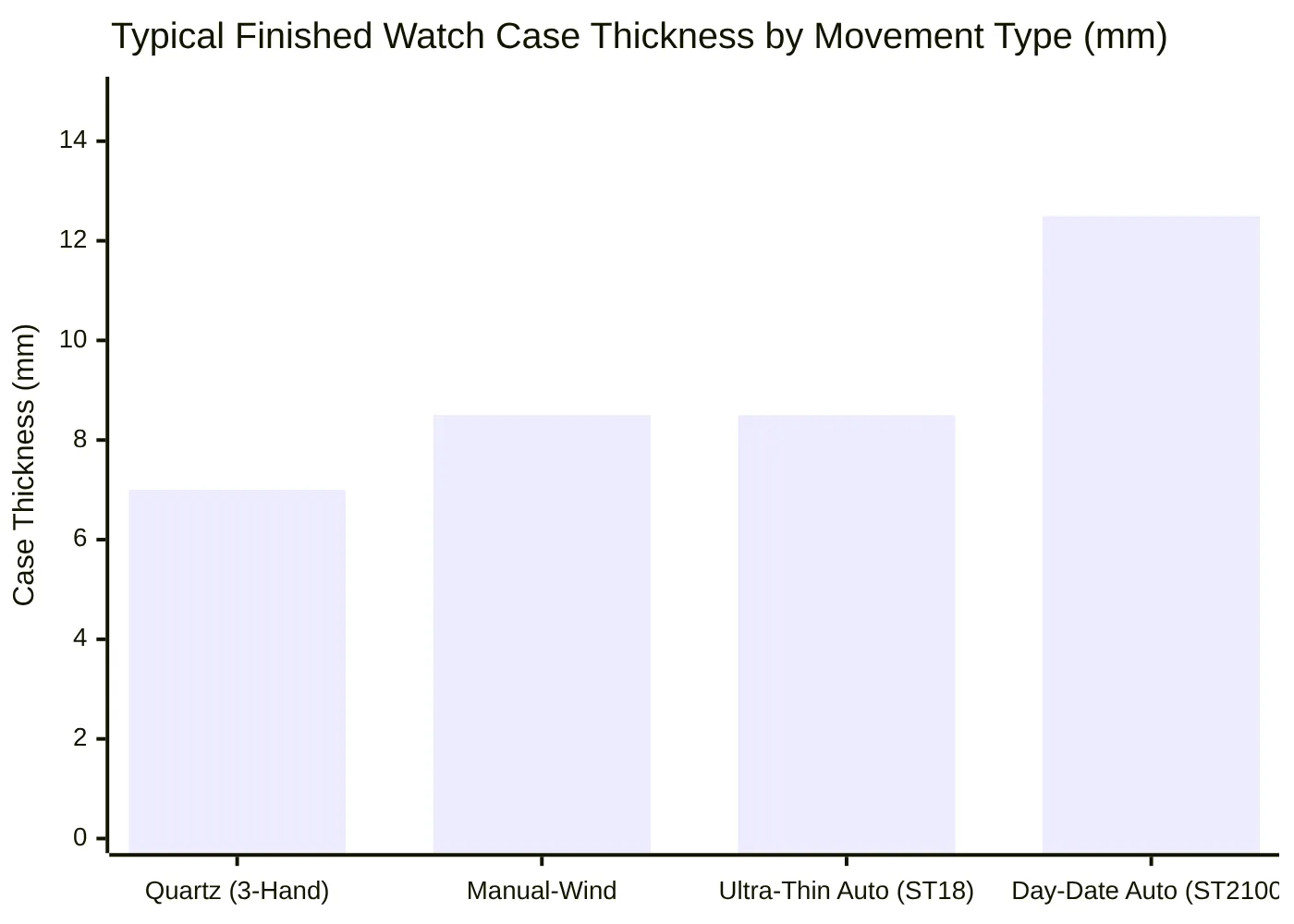
Analog quartz movements replace the traditional mainspring barrel, gear train, and rotor with a compact circuit and stepping motor. This allows for exceptionally thin cases that slip beneath the narrowest French cuffs and stay running in a watch box between wears, though they forgo the sweeping seconds hand and mechanical craft prized by traditional collectors.
Manual-wind mechanical calibers preserve the tactile ritual of a hand-wound mainspring while omitting the self-winding oscillating weight. Without a rotor bridge, watchmakers can house a traditional mechanical movement inside a slender dress profile. The subtle trade-off in winter is ergonomic: ultra-slim dress crowns sit flush against the case flank, which demands slightly finer finger dexterity during daily winding when hands are cold.
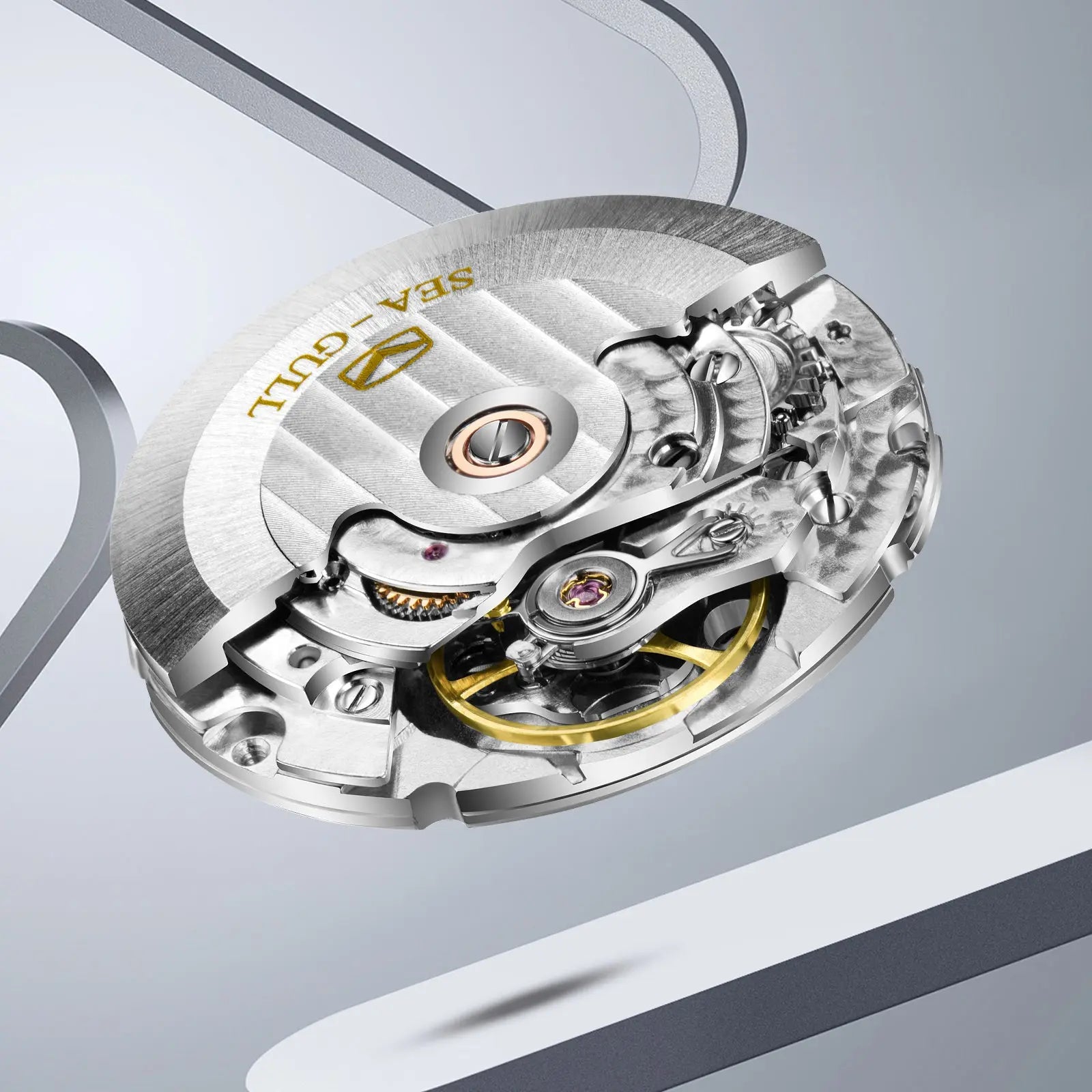
Automatic mechanical watches use wrist motion to replenish power continuously. While standard self-winding calibers—particularly those incorporating both day and date discs—require additional vertical space for the rotor arc and calendar mechanisms, specialized ultra-thin automatic movements such as the Sea-Gull ST18 compress the winding system to achieve dress-watch slimness around 8 mm to 9 mm without giving up self-winding convenience.

Three Proportions for Balancing Watch Case Thickness Under a Winter Coat Cuff
Rather than treating slimness as a single rule, a well-rounded winter rotation matches the proportions of the watch to the weight and cut of the day's garments. Three automatic models illustrate how distinct case geometries serve different cold-weather settings.
| Model | Case Diameter | Case Thickness | Lug-to-Lug Span | Movement | Band & Clasp | Water Resistance & Weight |
|---|---|---|---|---|---|---|
| Sea-Gull Classic Ultra-Thin Business Watch with Calendar (1091) | Approx. 34.5 mm | Approx. 8 mm | Unspecified | ST18 Automatic (24 jewels, 28,800 vph) | 18 mm 316L Steel Bracelet, Butterfly Buckle | 3 bar | 97 g |
| Seagull Business Ultra-Thin Men's Automatic Mechanical Watch (1076) | Approx. 39 mm | Approx. 9 mm | Approx. 44.5 mm | ST18 Automatic (24 jewels, 28,800 vph) | Leather Strap, Pin Buckle | 5 bar | 49 g |
| Sea-Gull Reissue Day-Date Watch (1075A) | Approx. 38 mm | Approx. 12.5 mm | Approx. 42 mm | ST2100 Automatic (28 jewels, 28,800 vph) | 20 mm 316L Steel Bracelet, Push-Button Hidden Clasp | 10 bar | 135 g |
For formal tailoring and crisp double cuffs, the Sea-Gull Classic Ultra-Thin Business Watch with Calendar offers the most compact footprint of the three. Measuring approximately 8 mm thick with a classical 34.5 mm 316L stainless steel case, it houses the 24-jewel ST18 automatic movement beneath a synthetic sapphire crystal. Its low vertical wall and 18 mm steel bracelet let tailored shirting fall past the wrist without interruption.

For wearers who prefer a contemporary dial opening without added bulk, the Seagull Business Ultra-Thin Men's Automatic Mechanical Watch 1076 pairs an approximately 39 mm diameter with a 9 mm case height. Driven by the same 28,800 vph ST18 automatic caliber, its restrained 44.5 mm lug-to-lug span keeps the case balanced across the flat of the wrist. At just 49 g on a leather strap, it brings an airy feel beneath layered business attire.
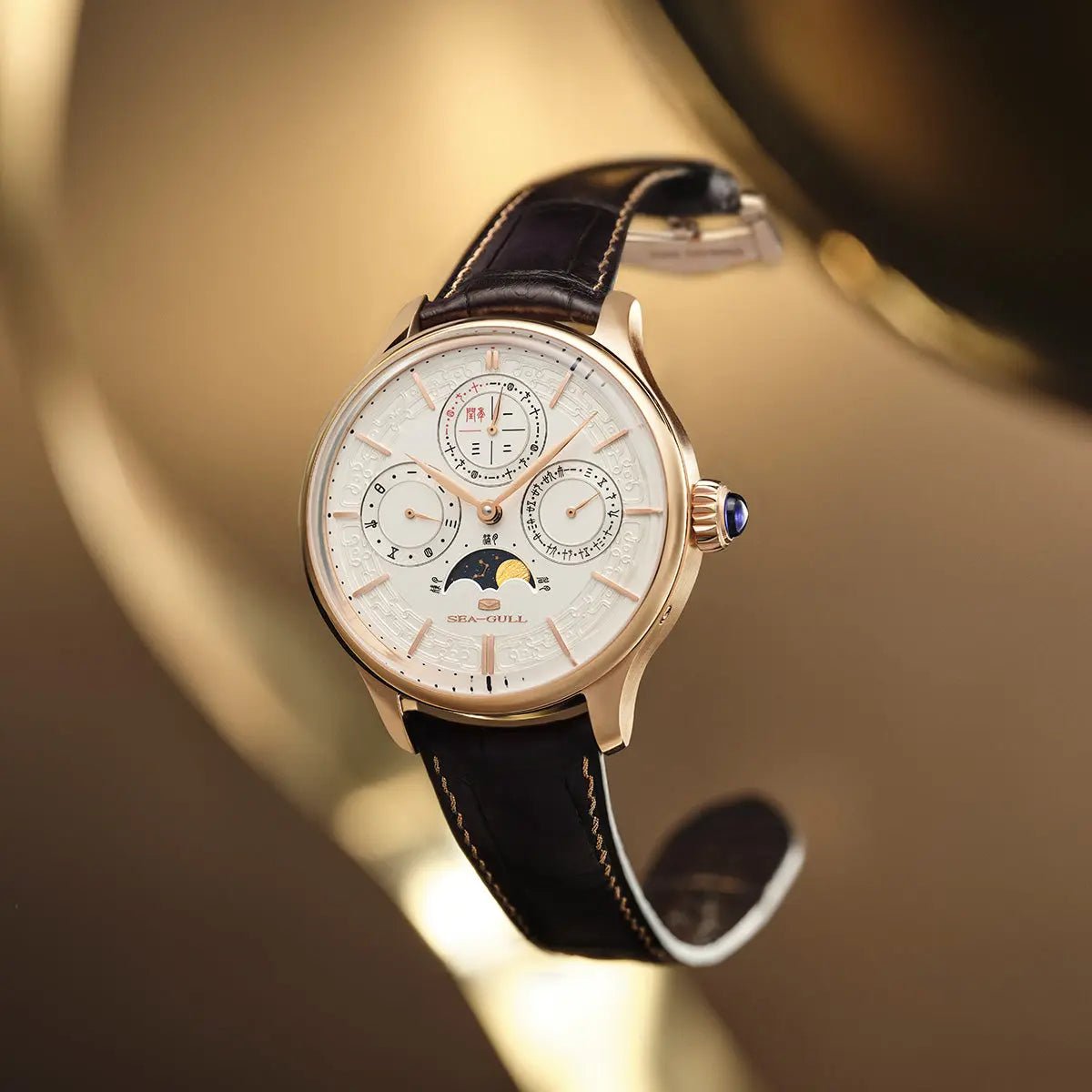
When the wardrobe shifts toward heavy-gauge cashmere, flannel, or tweed overcoats, a watch with stronger architectural presence feels right at home. The Sea-Gull Reissue Day-Date Watch features an approximately 12.5 mm case height to accommodate its 28-jewel ST2100 automatic day-date movement and 10 bar water resistance. What makes its 38 mm 316L stainless steel case remarkably wearable under relaxed barrel cuffs and sweater ribs is its compact 42 mm lug-to-lug span, which centers its 135 g mass neatly on the wrist while showcasing its fluted bezel and Ancient Cloud Motif dial.

How Straps and Clasps Affect Watch Case Thickness Under a Winter Coat Cuff
What happens at the underside of the wrist at six o'clock influences sleeve clearance just as much as the crystal at twelve o'clock. A shirt cuff encircles the entire wrist, meaning a bulky folding clasp can consume several millimeters of internal cuff allowance.
A traditional pin buckle on a two-piece leather strap—such as the setup on the 49 g reference 1076—lies flat against the wrist and warms quickly against the skin on frosty mornings. Because cold outdoor air causes slight wrist contraction, a pin buckle also makes it easy to tighten or loosen the strap by a single notch when moving between freezing commutes and heated interiors.
For those who favor the continuous drape of a 316L stainless steel bracelet, flush closure hardware prevents snagging on knit cuffs. Both the butterfly buckle on the 1091 and the push-button hidden clasp on the 1075A eliminate external clasp boxes, preserving an uninterrupted link contour that glides smoothly inside lined sleeves.
Ultimately, specifications serve best as thoughtful guides rather than rigid rules. Pairing ultra-thin silhouettes with structured formal shirting and reserving fuller, short-lugged day-date cases for relaxed knitwear and wool coats allows each piece in a collection to wear at its best throughout the colder months. For readers considering an addition to their seasonal rotation, new subscribers can receive 10% off their first order when joining the newsletter.

Leave a comment
This site is protected by hCaptcha and the hCaptcha Privacy Policy and Terms of Service apply.