

Shorter Days on the Trail: Reading the Time as Afternoon Light Fades
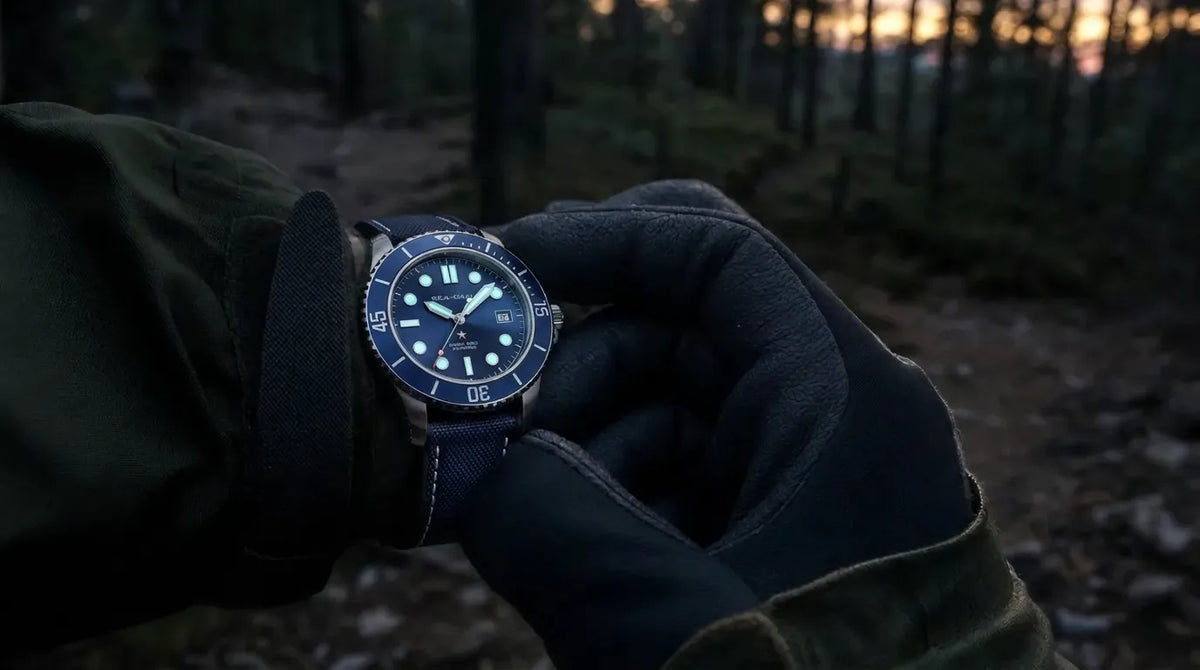
For legible timekeeping during low-light hikes, a watch dial must be designed for mesopic vision, which occurs when ambient light levels fall between $0.001\text{ cd/m}^2$ and $5\text{ cd/m}^2$ under forest canopies or canyon walls.
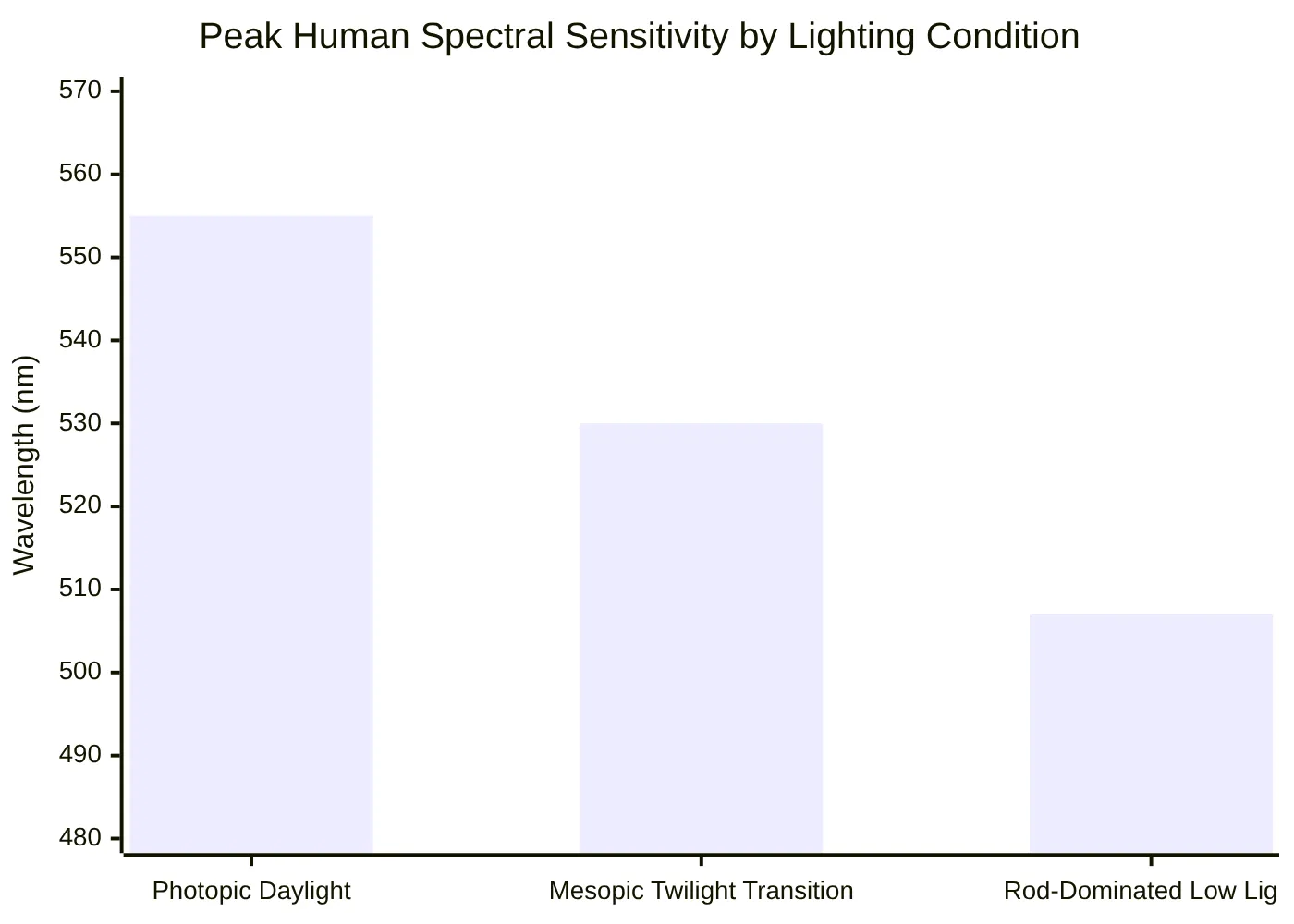
As daylight fades, the eye's cone cells become less sensitive, and rod photoreceptors activate.
As daylight fades, this physiological shift reduces spatial acuity, lowers contrast sensitivity, and triggers the Purkinje shift, moving peak human spectral sensitivity from 555 nm (yellow-green) toward 507 nm (blue-green).
Optical Requirements for a Legible Watch for Low Light Hiking
To ensure readability as ambient trail light diminishes, consider the following five dial and case parameters:
- Dial Contrast and Crystal Material: Select a dial with high luminance separation between the handset and the background surface. Synthetic sapphire crystals resist trail abrasions that scatter incoming canopy light and reduce contrast.
- Hand Proportions: Choose broad, opaque hand profiles over thin or skeletonized pointers. Ensure the hour hand is distinctly shorter or wider than the minute hand to prevent misreading during a rapid glance.
- Marker Scale and Bezel Orientation: Prioritize oversized geometric hour plots at the 12, 3, 6, and 9 o'clock positions. Use a rotating dive bezel to mark turnaround times and track elapsed hiking intervals by angular position.
- Visual Clutter Reduction: Use a three-hand layout with a single calendar aperture. Avoid multi-scale tachymeters, chronograph subdials, or dense paragraphs of dial text that obscure the minute track under reduced spatial acuity.
- Verified Luminous Elements: Confirm that the handset and markers carry luminous coatings. Expose photoluminescent dials to ambient light before entering dense timber; keeping the watch covered beneath a jacket cuff prevents light absorption.
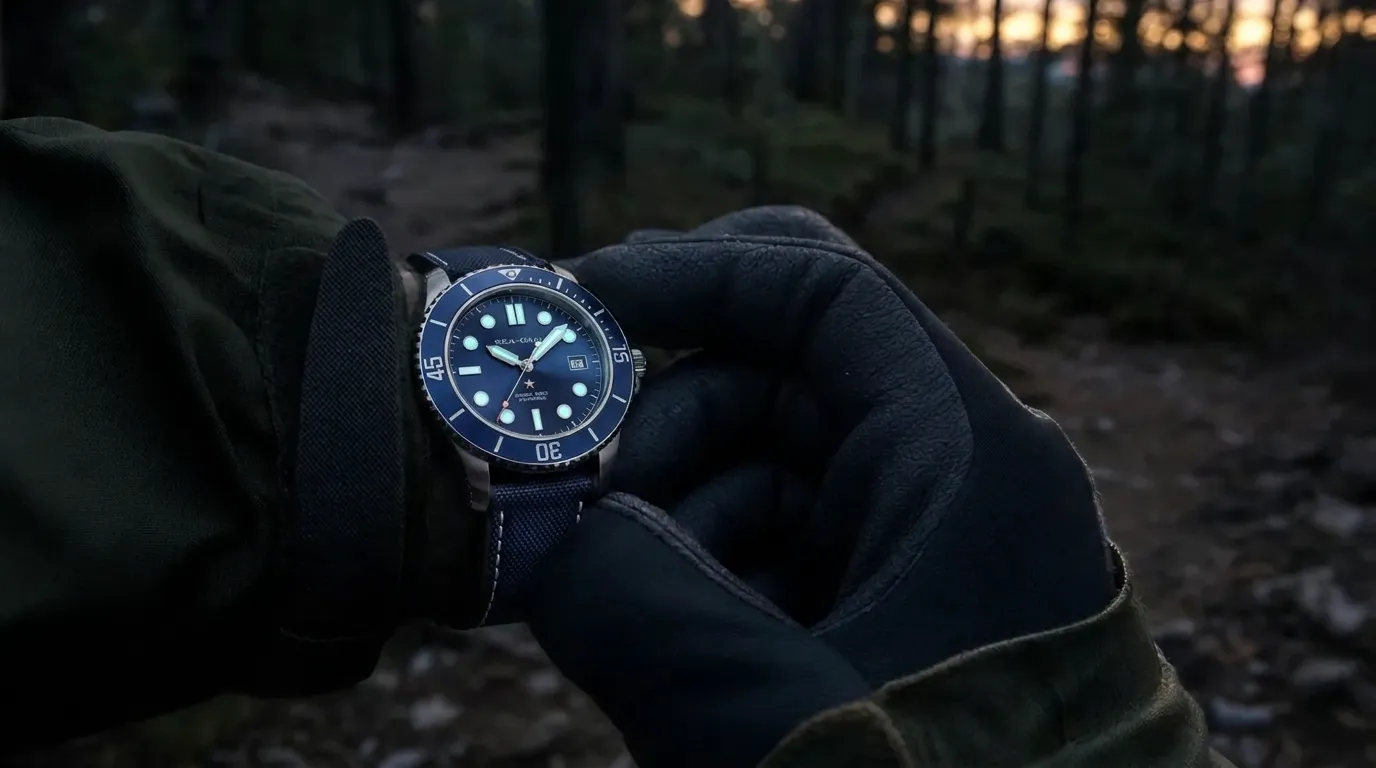
Comparing Sea-Gull Models as a Legible Watch for Low Light Hiking
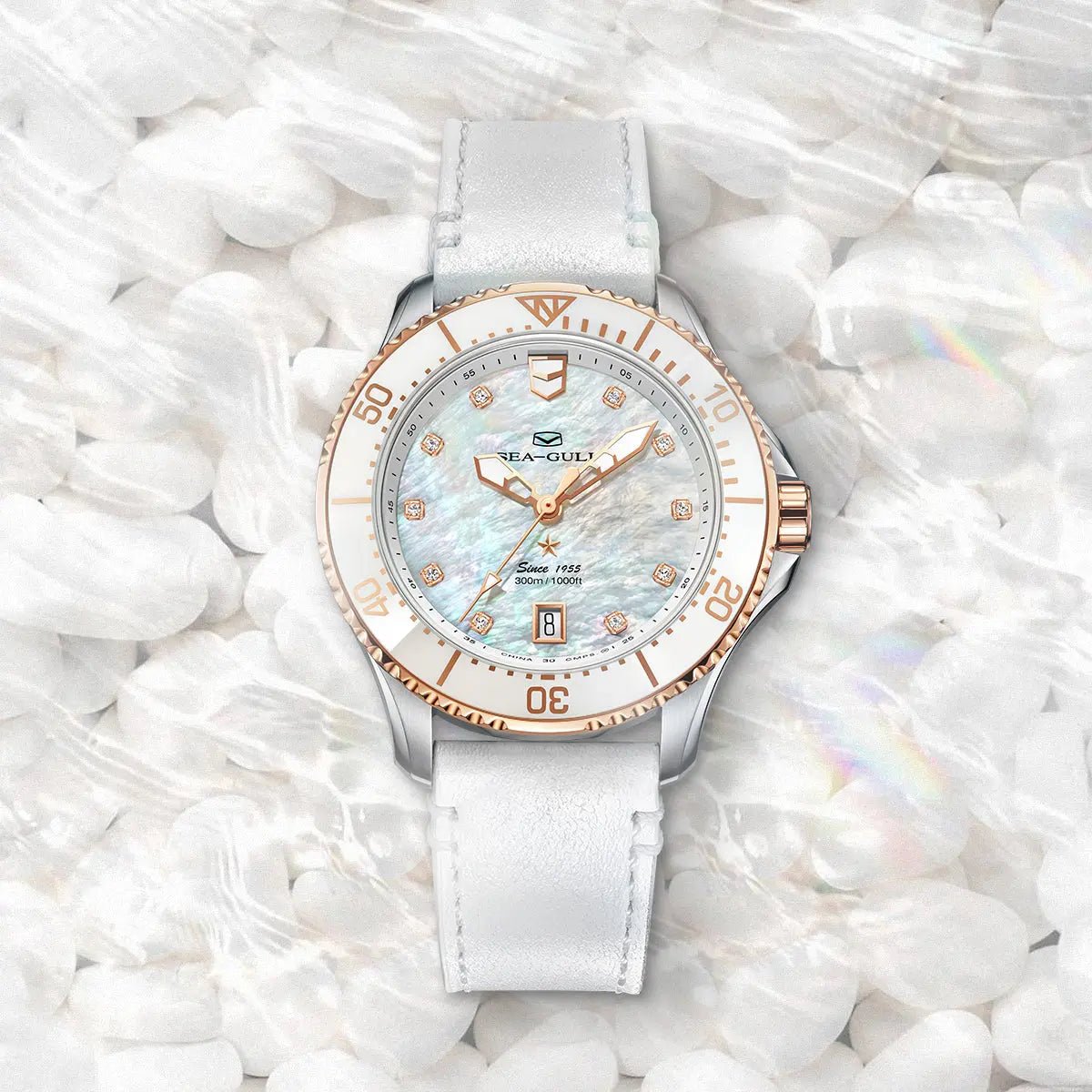
Dive watches, with their high-contrast dials, rotating elapsed-time bezels, synthetic sapphire crystals, and sealed 316L stainless steel cases, are well-suited for keeping time on low-light trails.
| Specification | Sea-Gull 6204 | Sea-Gull 1213 | Sea-Gull 1216 |
|---|---|---|---|
| Reference Numbers | 814.37.6204 |
816.22.1213 | 816.32.1213 | 816.92.1213
|
811.12.1216 | 811.22.1216 | 811.32.1216 | 811.52.1216
|
| Case Dimensions | 40 mm diameter x 12.7 mm thickness | 41 mm diameter x 13.5 mm thickness | 44 mm diameter x 13.6 mm thickness |
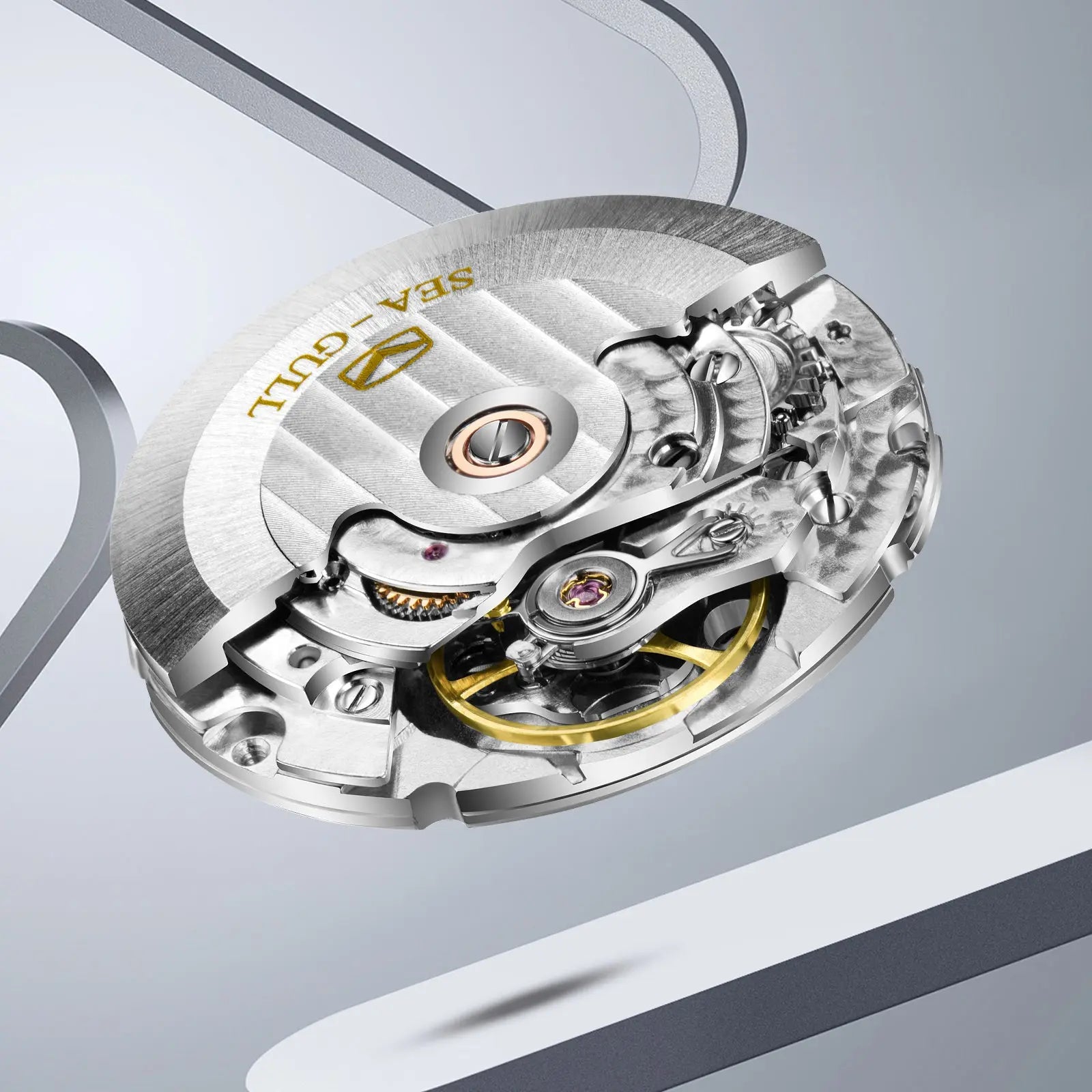
| Movement | Automatic (ST2147, 25 jewels, 21,600 vph) | Automatic (ST2130, 28 jewels, 28,800 vph) | Automatic (ST2130, 28 jewels, 28,800 vph, 42h power reserve) |
| Crystal & Bezel | Synthetic sapphire crystal; dive bezel | Synthetic sapphire crystal; sapphire bezel with north-pointing indicator | Synthetic sapphire crystal; scratch-resistant rotating bezel |
| Luminous & Dial Details | Luminous display; calendar | Engineered hour markers; luminous display; small dial layout; calendar | Luminous green hands; scale-textured dial; calendar |
| Rated Water Resistance | 20 Bar (approx. 200 m) | 30 Bar (approx. 300 m) | 30 Bar (approx. 300 m) |
| Strap & Net Weight | 20 mm silicone (92 g) or 316L steel (167 g) | 20 mm 316L steel bracelet with safety buckle (183 g) | 22 mm dual strap (nylon and 316L steel, 105 g) |
Compact Cuff Clearance: Sea-Gull 6204
For those who prefer a watch that slips easily under tight cold-weather shell cuffs, the Sea-Gull 6204 is a suitable choice.
With its 40 mm diameter, 12.7 mm thickness, and a 92 g silicone strap, this model minimizes wrist bulk. It includes a synthetic sapphire crystal, a calendar display, a dive bezel, and luminous markings.
Focused Instrument Layout: Sea-Gull 1213
The Sea-Gull 1213 is an excellent choice for those who value focused dial geometry and a high-frequency mechanical movement.
The 41 mm stainless steel case encloses the 28,800 vph ST2130 automatic caliber. It features engineered hour markers, a focused small dial aperture, a luminous display, and a sapphire bezel with a north-pointing indicator.
Broad Dial Canvas and Green Hands: Sea-Gull 1216
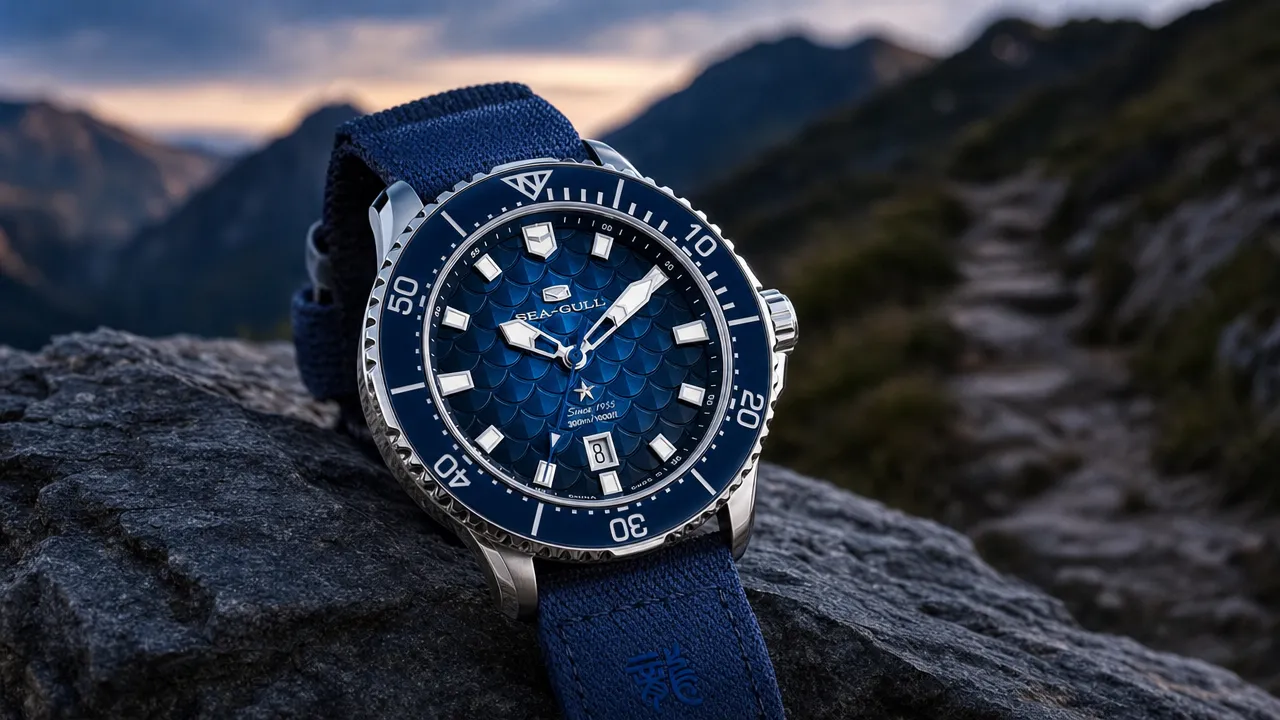
For maximum dial diameter and enhanced green-spectrum hand visibility, choose the Sea-Gull 1216.
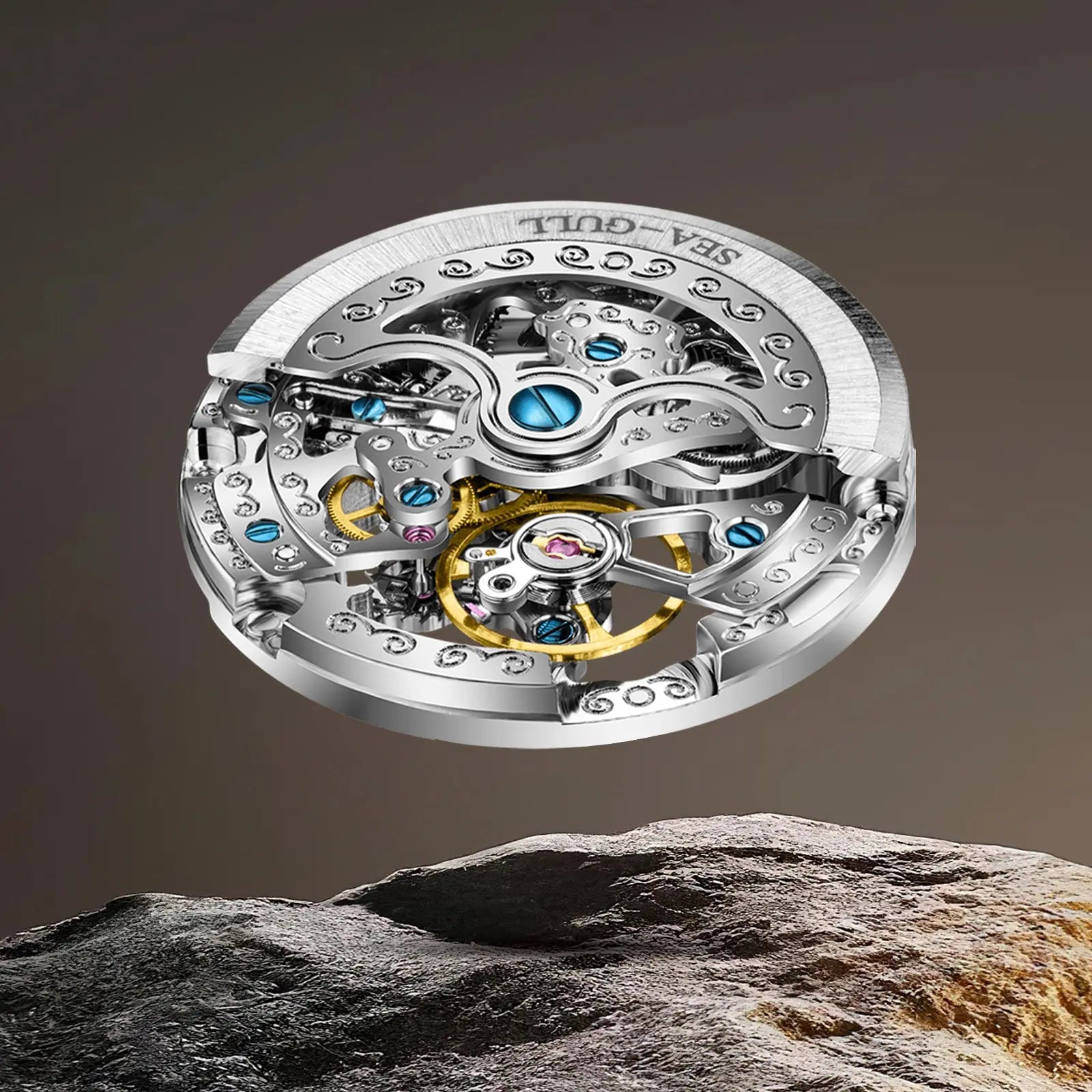
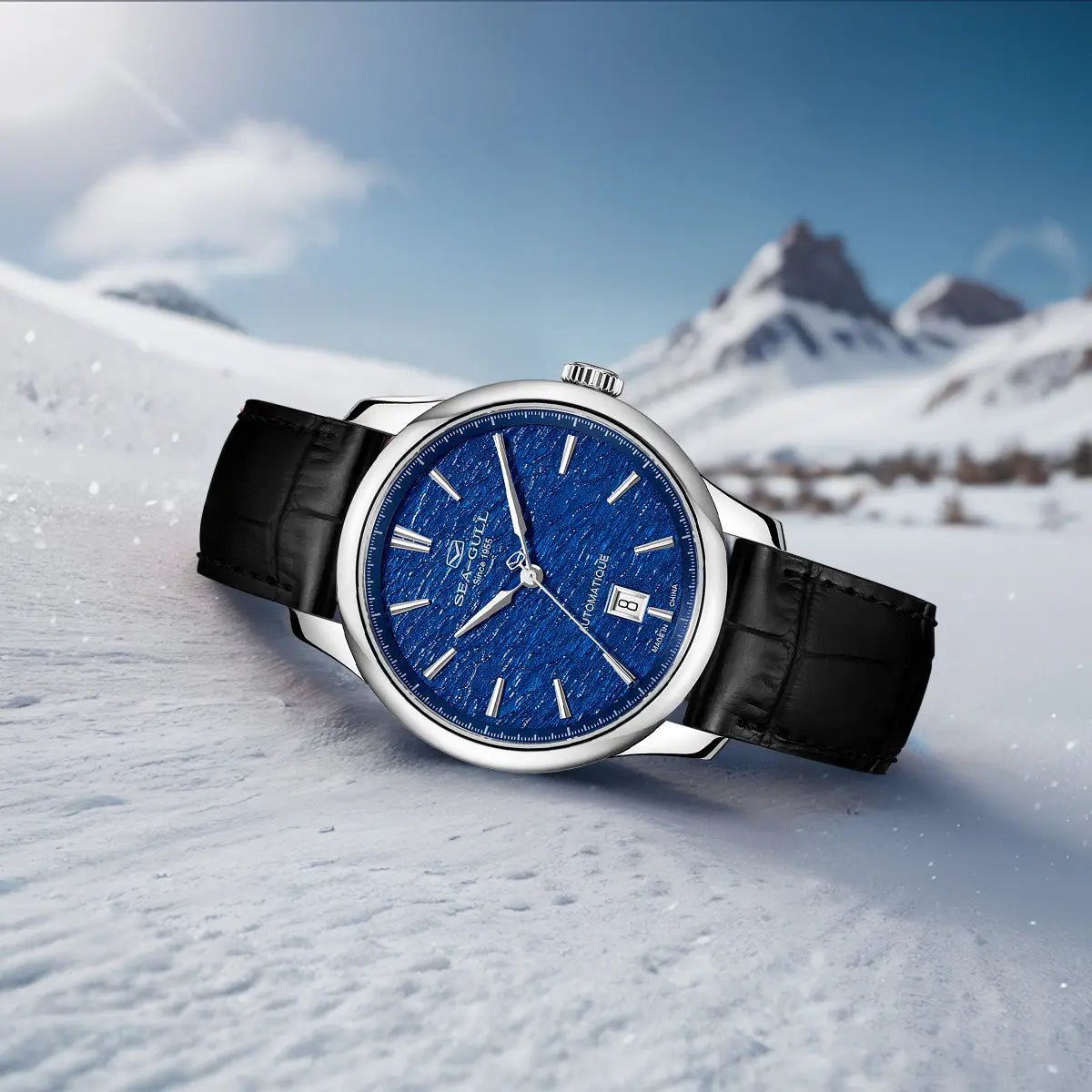
The 44 mm case features luminous green hands that align with the eye's mesopic Purkinje shift toward shorter wavelengths. This feature offsets the visual complexity of its Dragon Kings scale-textured dial. The watch weighs 105 g with its 22 mm nylon and steel dual-strap setup.
Operating Steps for Trail Pacing with a Mechanical Watch
To ensure precise timekeeping and dial legibility during an afternoon hike, follow these steps:
- Verify Mainspring Torque: Wind manual-wind movements fully before departure, or wear an automatic watch continuously so arm motion maintains mainspring power (such as the 42-hour reserve on the ST2130 caliber in the 1216).
- Expose Luminous Markers to Light: Keep the watch crystal uncovered for 10 to 15 minutes before entering dark canyon bottoms or thick forest cover to charge the luminous material.
- Set the Turnaround Bezel: Rotate the dive bezel to align the primary reference marker with your mandatory turnaround minute on the main dial.
- Monitor Thermal Exposure: Keep quartz watches insulated under a sleeve during sub-freezing conditions to prevent battery voltage drop, and avoid operating small mechanical crowns with numb or gloved fingers.
Water Resistance Conditions and Case Maintenance
The stated water resistance ratings—20 Bar (200 meters) for the 6204 and 30 Bar (300 meters) for the 1213 and 1216—reflect static laboratory pressure tests and are not a permanent guarantee.
These seals protect the movement from heavy autumn rain, perspiration, condensation caused by rapid temperature drops, and stream splashes.
Regularly inspect case gaskets, confirm the crown is fully secured before venturing onto the trail, and protect any mechanical watch from sudden thermal shock in icy water.
Mandatory Trail Safety Precautions and Equipment Exclusions
A wristwatch provides timekeeping and pacing convenience; it is not emergency or navigation gear.
Luminous hands allow for reading the dial but offer no illumination for terrain hazards.
While a bezel with a north-pointing indicator can offer some directional reference, it is not a substitute for a magnetic baseplate compass and a physical topographic map.
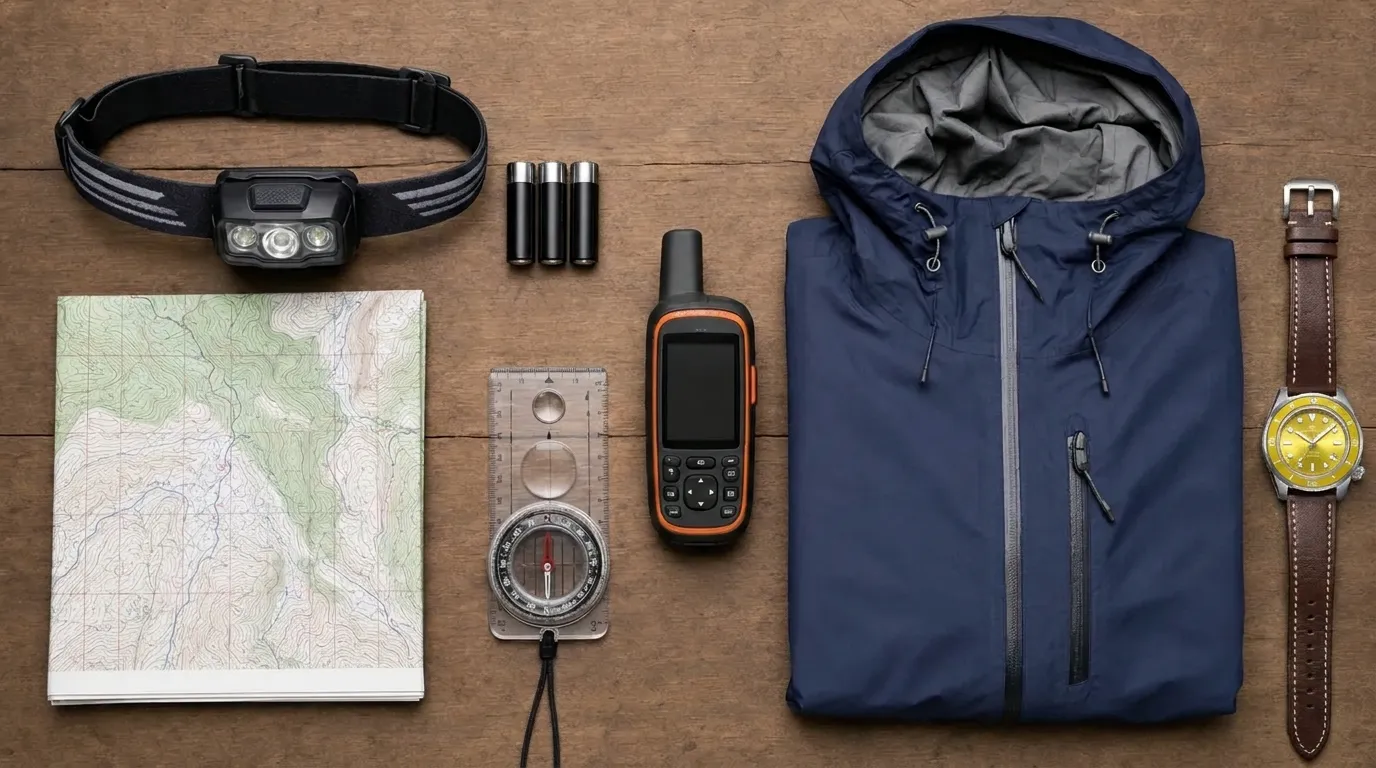
Drawing from the U.S. National Park Service hiking safety guidelines and The Mountaineers Ten Essentials protocol, hikers should always carry this essential equipment:
- Dedicated Illumination: Pack a headlamp or flashlight plus spare batteries; neither a wristwatch nor a smartphone flashlight meets backcountry lighting requirements.
- Redundant Navigation: Carry a physical topographic map, a magnetic compass, and a GPS unit.
- Emergency Communication: Carry a satellite messenger or personal locator beacon (PLB) and leave a trip schedule with an emergency contact.
- Weather-Appropriate Protection: Pack moisture-wicking non-cotton base layers, an insulating mid-layer, a waterproof outer shell, emergency shelter, extra food, water, and footwear traction devices.

コメントを書く
このサイトはhCaptchaによって保護されており、hCaptchaプライバシーポリシーおよび利用規約が適用されます。