











Artículo: Reading the Date on a Winter Morning: Layout, Scale, and Contrast

Reading the Date on a Winter Morning: Layout, Scale, and Contrast
Early winter daylight brings a particular quality of light into a room. Filtered through overcast skies or entering a window at a low angle, morning illumination is soft, diffuse, and directional. When checking a mechanical wristwatch before starting the day, the challenge is rarely total darkness. Instead, it is how quickly the eye can resolve a small recessed numeral when surface highlights are muted and oblique shadows gather inside the dial cutout.
In these everyday conditions, reading the date quickly becomes a study in dial architecture. Five interrelated variables determine how naturally a calendar indication registers: window placement, typography, case and aperture scale, surrounding dial space, and figure-ground contrast.

Why Soft Morning Light Tests Dial Architecture
Unlike bright midday sun, pale morning light softens reflections across a dial plate while casting subtle shadows along any vertical step. In a mechanical calendar watch, the rotating date ring—and, in dual-calendar movements, the accompanying day wheel—sits on a plane slightly beneath the main dial surface. If the cutout walls are raw or overly deep, low-angle light can shade the top half of the printed digit.
Watchmakers address optical depth through aperture framing and crystal selection. An applied metallic border or beveled edge around the window catches ambient light at oblique angles, defining the cutout's boundary and visually bridging the step down to the calendar disc. Above the dial, a flat synthetic sapphire crystal provides a clear, undistorted view across the face without the off-axis glare that can accompany a magnifying lens.
Within the frame itself, quick recognition relies on strong figure-ground contrast and clear typography. As noted in technical analyses by WorldTempus and Horopedia, dark numerals on a bright, low-reflectance disc are easily read in soft ambient light. The proportions of the numerals are equally important: upright digits with balanced stroke weights and open internal counters—the enclosed negative spaces inside numbers like 3, 6, 8, and 9—prevent double-digit dates from blurring together at normal viewing distances.
Single Date vs. Day-Date: Choosing Your Visual Hierarchy
Choosing between a dual-calendar layout and a single-date display means weighing how much information appears at a glance against the openness of the dial.
The Dual-Calendar Approach: 38mm Reissue Proportions
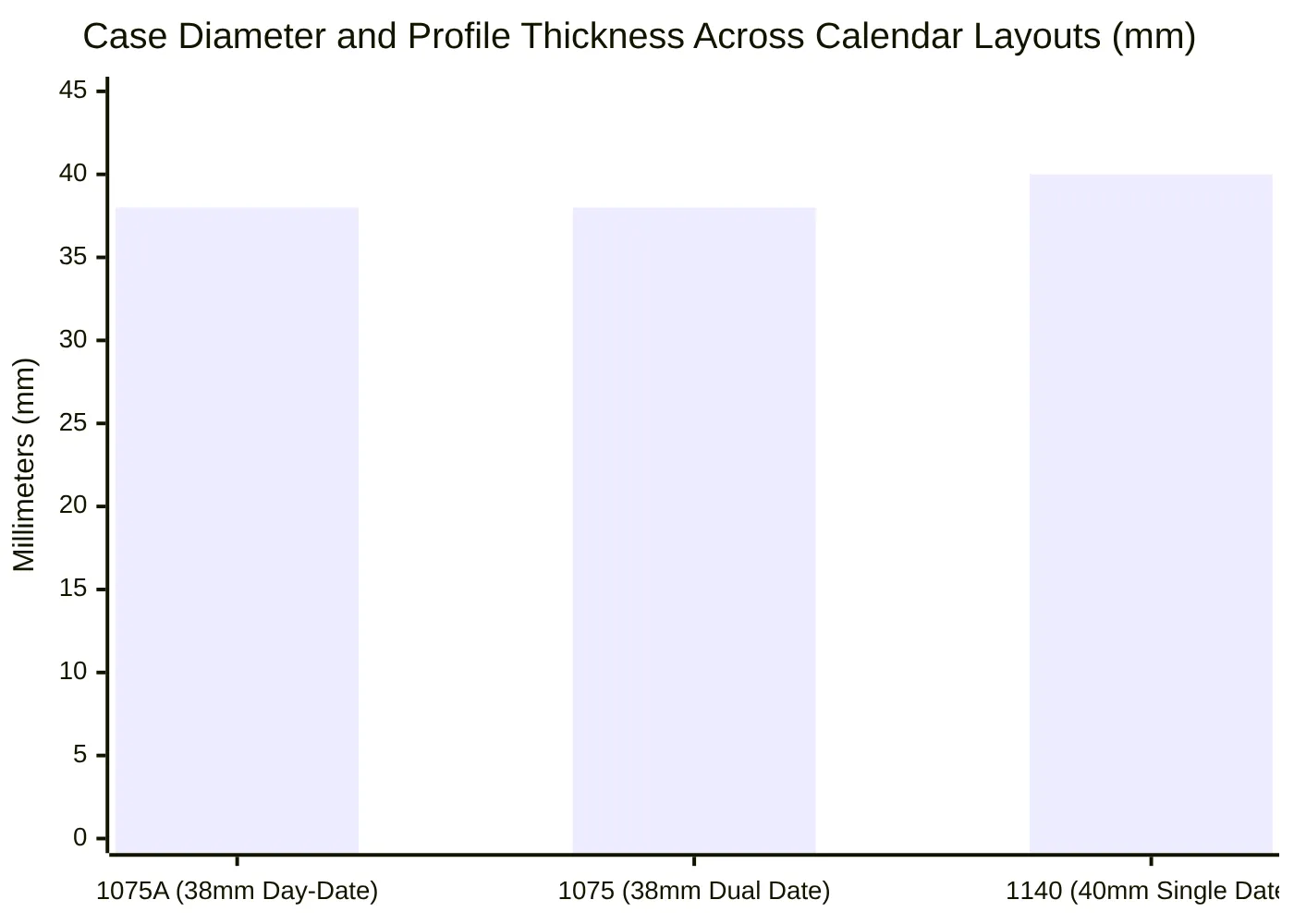
For those who prefer a complete weekday and numeric orientation in a single view, the Reissue Fluted Bezel Day-Date Display 1075A and the Retro Reissue Dual Date 1075 offer two distinct takes on a classic 38mm dress-watch design. Both models feature 316L stainless steel cases, synthetic sapphire crystals, and a water resistance rating of 10 Bar (a laboratory-tested pressure rating). They are powered by the 28-jewel ST2100 automatic movement, which beats at 28,800 vibrations per hour. For more on how these compact proportions wear in daily use, see our 38mm automatic watch review.
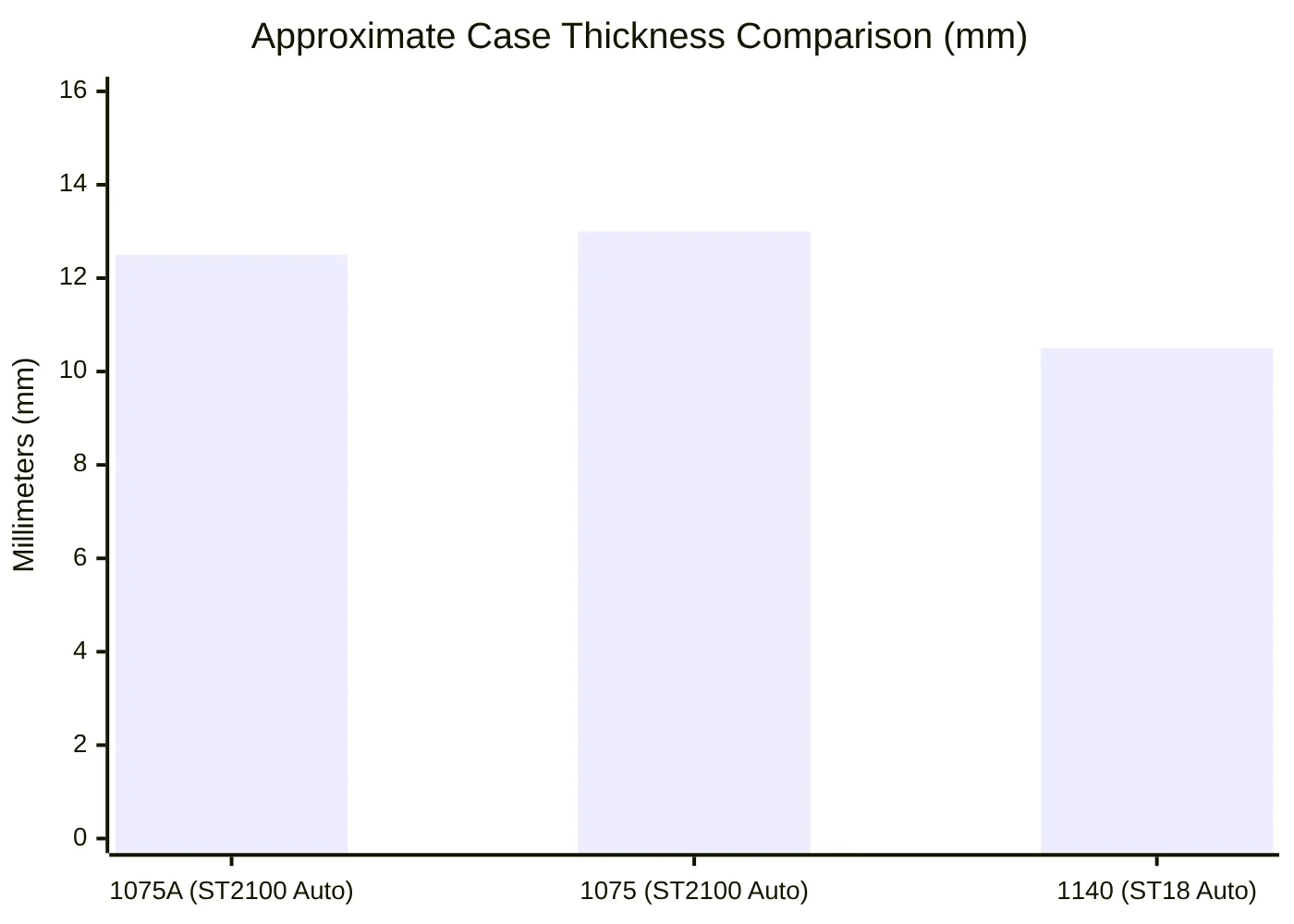
On the 1075—explored in detail in our technical overview of Reference 816.12.1075—a synchronized day and date window sits side by side at 3 o'clock, framed by a metallic border. Positioned along the wrist's horizontal axis, the aperture is immediately visible as the watch emerges from a sleeve. The clean white dial, applied baton markers, and triangular fluted bezel keep the left side of the dial uncluttered, allowing the framed dual window to anchor the composition. While the calendar discs themselves rely on ambient light and crisp dark-on-light contrast for reading, the hands and hour markers feature luminous material for time orientation in dim early-morning rooms. Its case measures approximately 13mm thick, with a lug-to-lug span of about 48.5mm.

The 1075A refines the profile to approximately 12.5mm thick with a compact 42mm lug-to-lug length. It introduces a textured Ancient Cloud Motif dial, available in Blue, Silver, and Golden colorways. Because this decorative motif creates dynamic surface play across the dial, the defined framing around the calendar readout becomes essential. It separates the upright numerals from the surrounding cloud pattern as the fluted bezel catches oblique window light.
The Single-Date Canvas: 40mm Business Clarity
Omitting the weekday indicator changes the dial's spatial geometry when the morning routine only requires verifying the date. The Business Calendar Classic 1140 features a 40mm case diameter and a slimmer profile of approximately 10.5mm in thickness, with a 46mm lug-to-lug measurement. It is powered by the 24-jewel ST18 automatic caliber, operating at 28,800 vibrations per hour. This model comes with a 316L stainless steel bracelet, a synthetic sapphire crystal, and has a water resistance rating of 5 Bar.
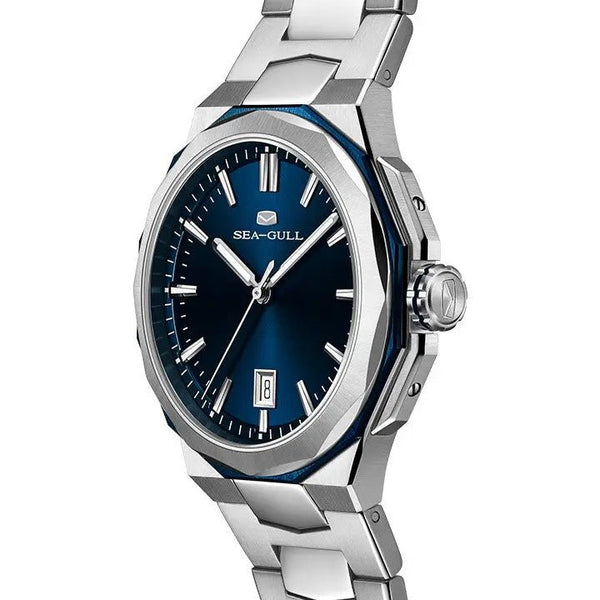
Pairing a wider 40mm dial with a single date aperture, the 1140 offers generous, unbroken negative space around the indices. Available with Blue and White dial variations, it allows the wearer to choose between two distinct contrast profiles: the White dial maintains an even, low-key tonal continuity across the face, while the Blue dial creates strong figure-ground separation that draws the eye directly to the lighter date window. Like the 1075, the 1140 incorporates luminous material on the hands and markers for checking the hour in low light, leaving the clean geometry of the date cutout to handle calendar reading once ambient daylight reaches the wrist.
Architectural Comparison Across Layouts
| Model & Reference | Calendar Layout | Case Proportions | Movement & Jewels | Dial Options & Features | Rated Water Resistance |
|---|---|---|---|---|---|
Reissue Day-Date 1075A (816.32.1075A) |
Dual Day-Date display | 38mm diameter | ~12.5mm thick | ~42mm lug-to-lug | ST2100 Automatic (28 jewels, 28,800 vph) | Blue, Silver, or Golden Ancient Cloud Motif dial; fluted bezel | 10 Bar (100m rated condition) |
Retro Reissue Dual Date 1075 (816.12.1075) |
Synchronized Day-Date at 3 o'clock | 38mm diameter | ~13mm thick | ~48.5mm lug-to-lug | ST2100 Automatic (28 jewels, 28,800 vph) | White dial; framed aperture; luminous hands and markers | 10 Bar (100m rated condition) |
Business Calendar Classic 1140 (836.12.1140) |
Single Date display | 40mm diameter | ~10.5mm thick | ~46mm lug-to-lug | ST18 Automatic (24 jewels, 28,800 vph) | Blue or White dial; luminous hands and markers | 5 Bar (50m rated condition) |
Matching the Layout to Your Morning Routine
Selecting the right calendar architecture comes down to how you process visual information at the start of the day. If you value seeing both the day of the week and the date framed together within a traditional 38mm case, the 1075 offers high-contrast simplicity against a white dial, while the 1075A pairs that dual readout with the tactile heritage of an Ancient Cloud Motif surface and a shorter 42mm lug-to-lug footprint. If you prefer a calmer, wider dial where a single date numeral sits within a slimmer 10.5mm case profile, the 40mm 1140 delivers uncluttered business clarity.
All three watches are powered by self-winding mechanical calibers, ensuring the calendar advances with the wearer's daily motion. This offers a practical convenience for an everyday calendar watch, in contrast to manual-wind movements, which appeal to enthusiasts who enjoy the daily ritual of winding and the unobstructed view of the movement. Whichever layout suits your personal style, new subscribers to the newsletter can receive 10% off their first order when choosing their next mechanical companion.


Dejar un comentario
Este sitio está protegido por hCaptcha y se aplican la Política de privacidad de hCaptcha y los Términos del servicio.