



After-Sunset Bike Commutes: Where a Luminous Watch Fits in a Real Visibility Plan
A luminous watch for night cycling serves as a secondary, off-handlebar timekeeper, utilized exclusively when the bicycle is at a complete stop. It does not provide forward or rear safety illumination, nor does it enhance rider visibility to motorists. It never replaces active bicycle lights, passive reflectors, or route planning.
Primary Visibility Rules Before Using a Luminous Watch for Night Cycling
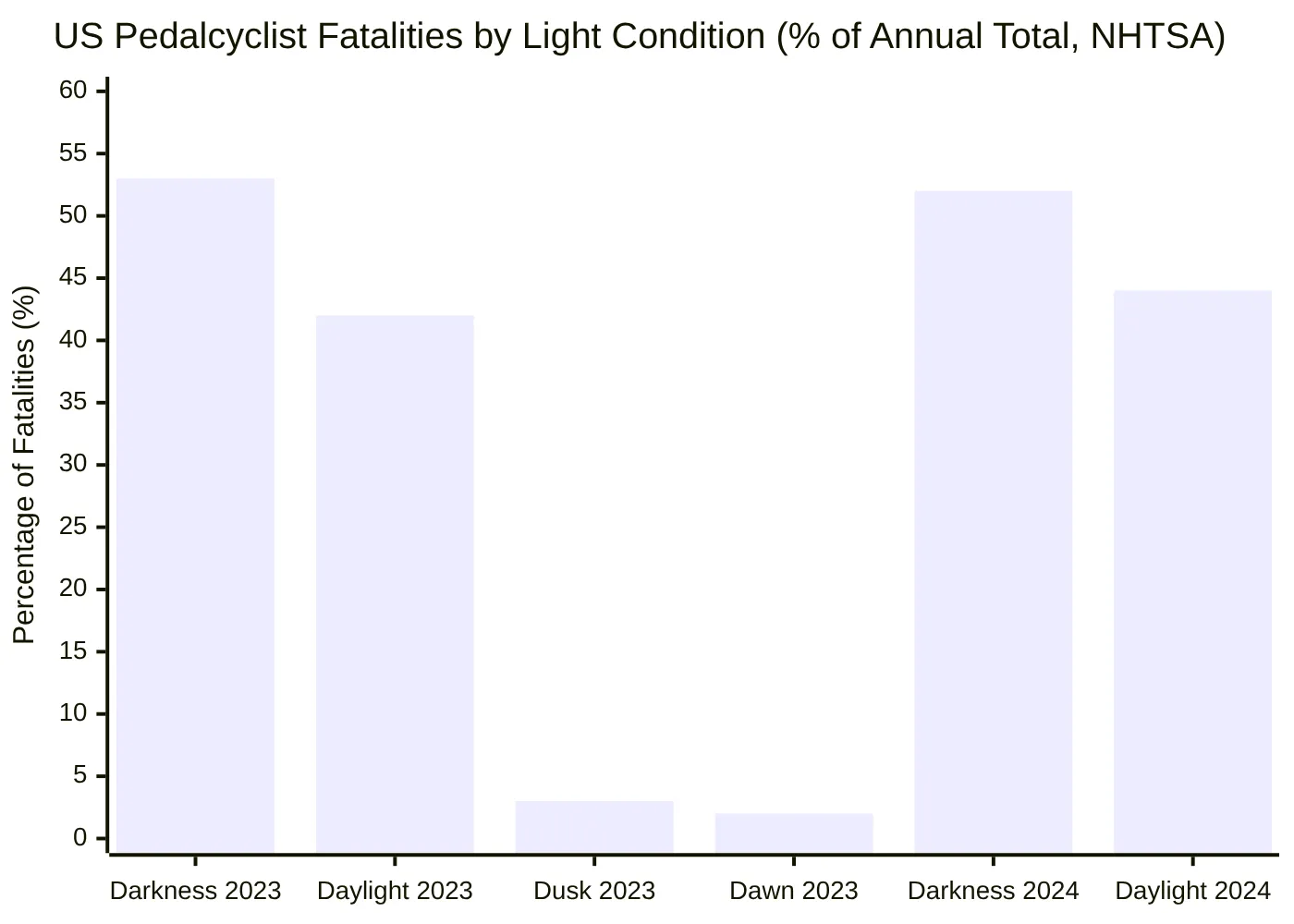
Data from the National Highway Traffic Safety Administration (NHTSA) indicates that over half of all U.S. pedalcyclist fatalities happen in darkness: 52% in 2021, 51% in 2022, 53% in 2023, and 52% in 2024. For 2023, the highest number of weekday fatalities occurred during the evening commute between 6:00 p.m. and 8:59 p.m., with intersections being the site of 28% of these fatal incidents.
Mandatory Pre-Ride Equipment Hierarchy
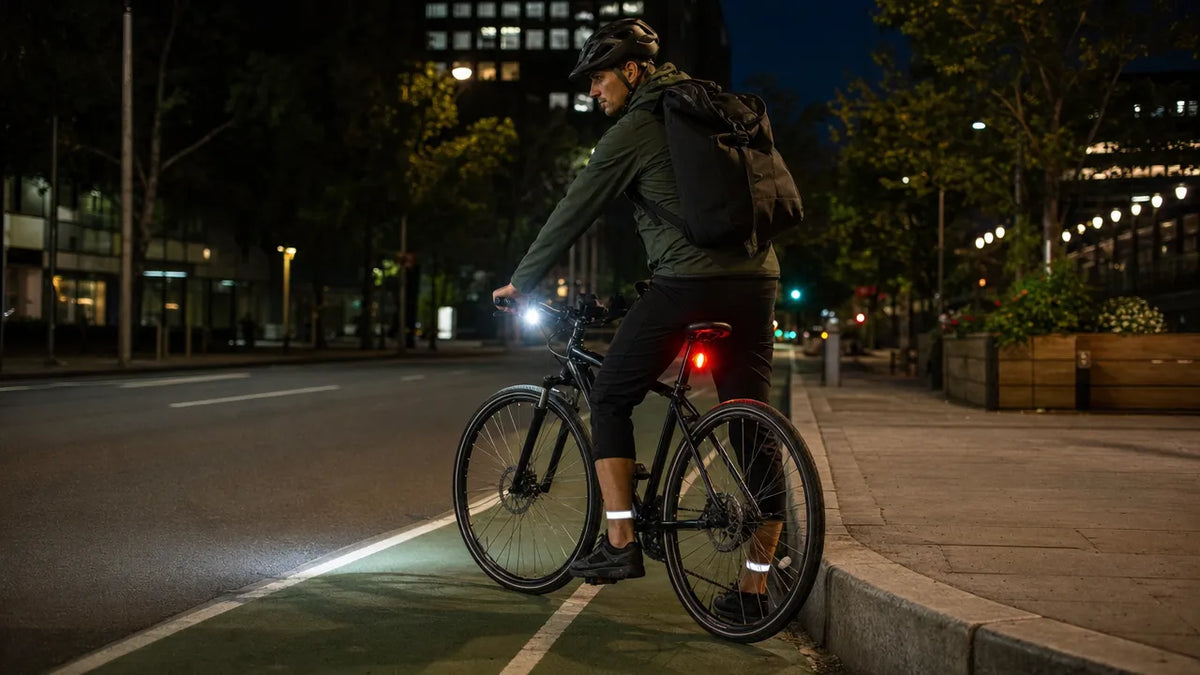
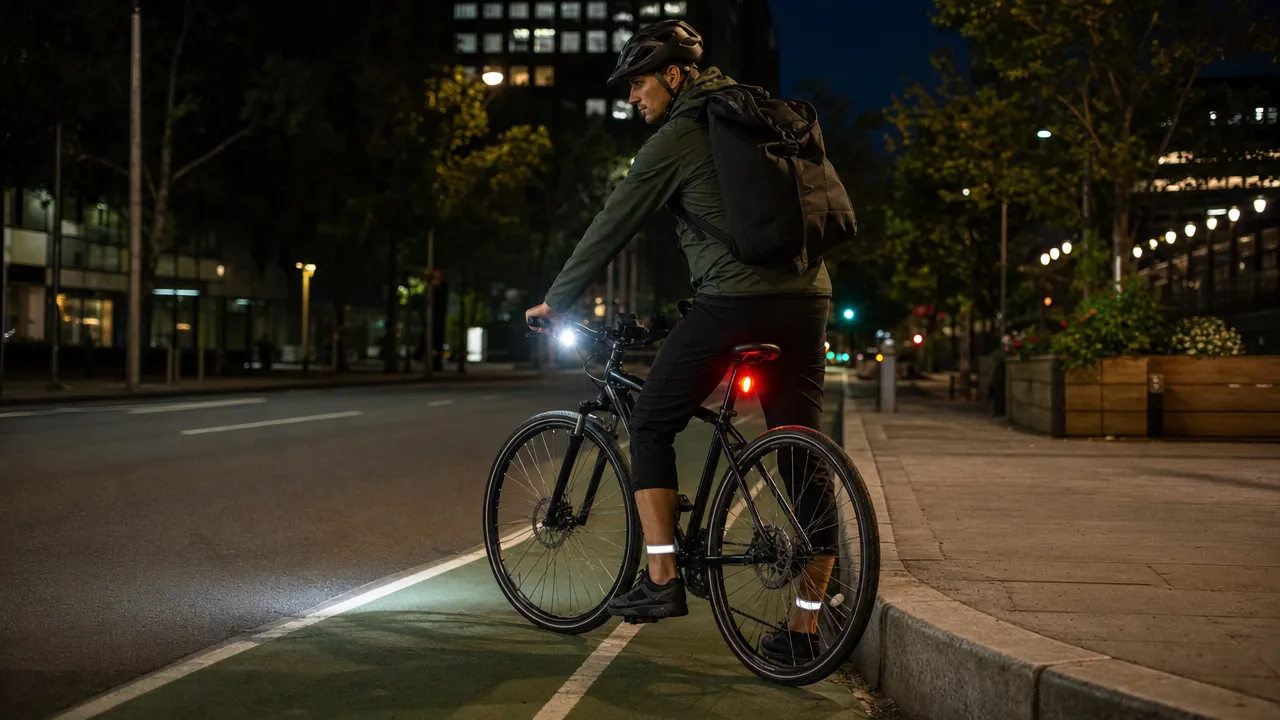
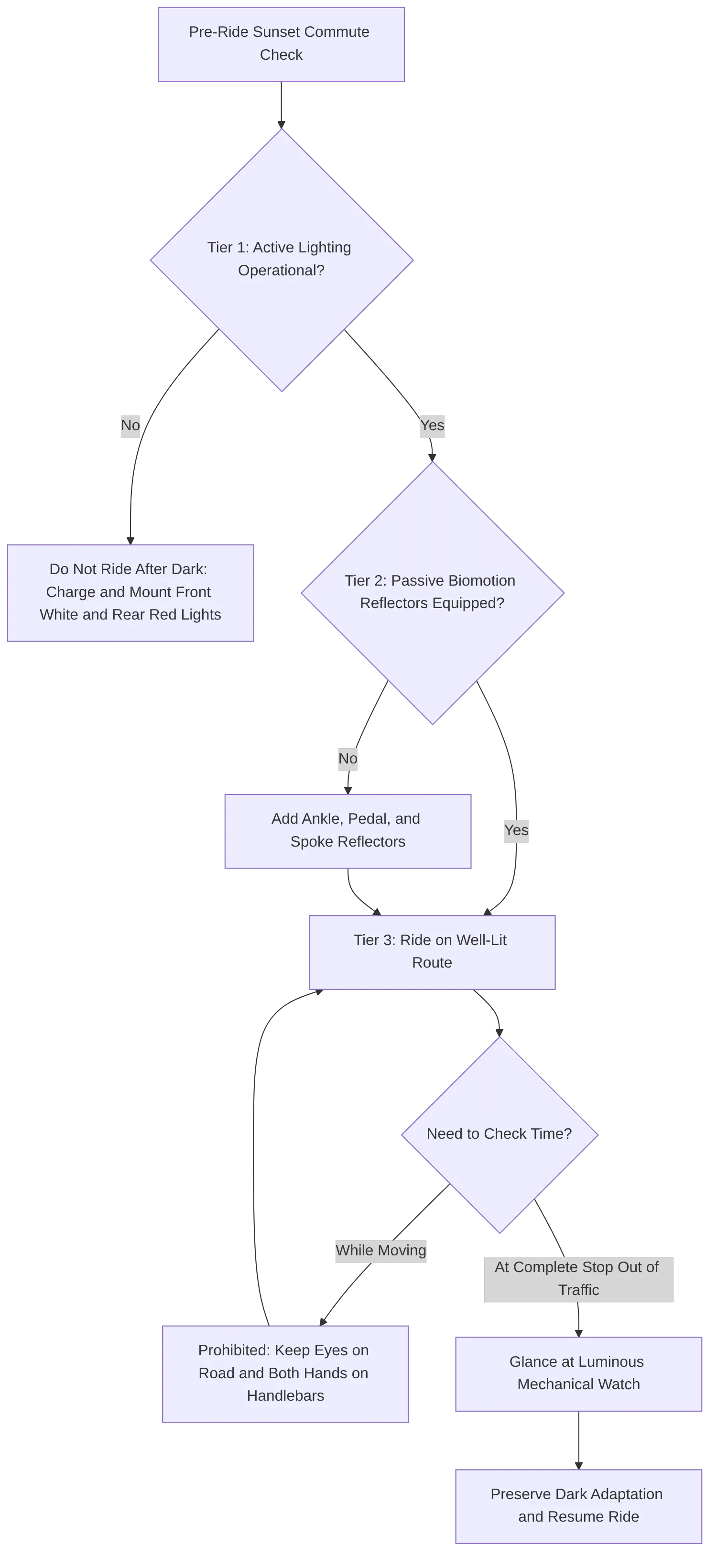
- Tier 1 Active Illumination: Mount an operational front white headlight and a rear red light before riding at dusk or night, in accordance with NHTSA bicycle safety countermeasures. Set the front headlight to a steady beam in dark conditions so oncoming traffic can judge distance and closing speed accurately.
- Tier 2 Passive Retroreflectivity and Biomotion: Attach retroreflective ankle bands, pedal reflectors, and spoke or tire-sidewall reflectors. Closed-course visibility testing in Transportation Research Part F confirms that highlighting the up-and-down biological motion of the lower legs produces longer driver recognition distances than static torso vests alone, while fluorescent fabrics fail in darkness due to the absence of ultraviolet wavelengths.
- Tier 3 Route Selection: Select illuminated streets or protected cycling corridors rather than unlit paths after sunset.
Operating Steps and Precautions for Checking Time After Sunset
Glancing at a watch while riding can disrupt steering balance and the ability to scan the road ahead. Even a brief look away from the path for 1.5 to 2 seconds, when traveling at 15 mph (24 km/h), means the bicycle covers 33 to 44 feet (10 to 13.4 meters) without the rider detecting potential hazards.
Safe Time-Check Procedure
- Decelerate and bring the bicycle to a complete stop at a red traffic signal or designated pull-off area clear of moving traffic.
- Keep at least one hand on the handlebar brake lever and stabilize the frame with one foot planted on the ground.
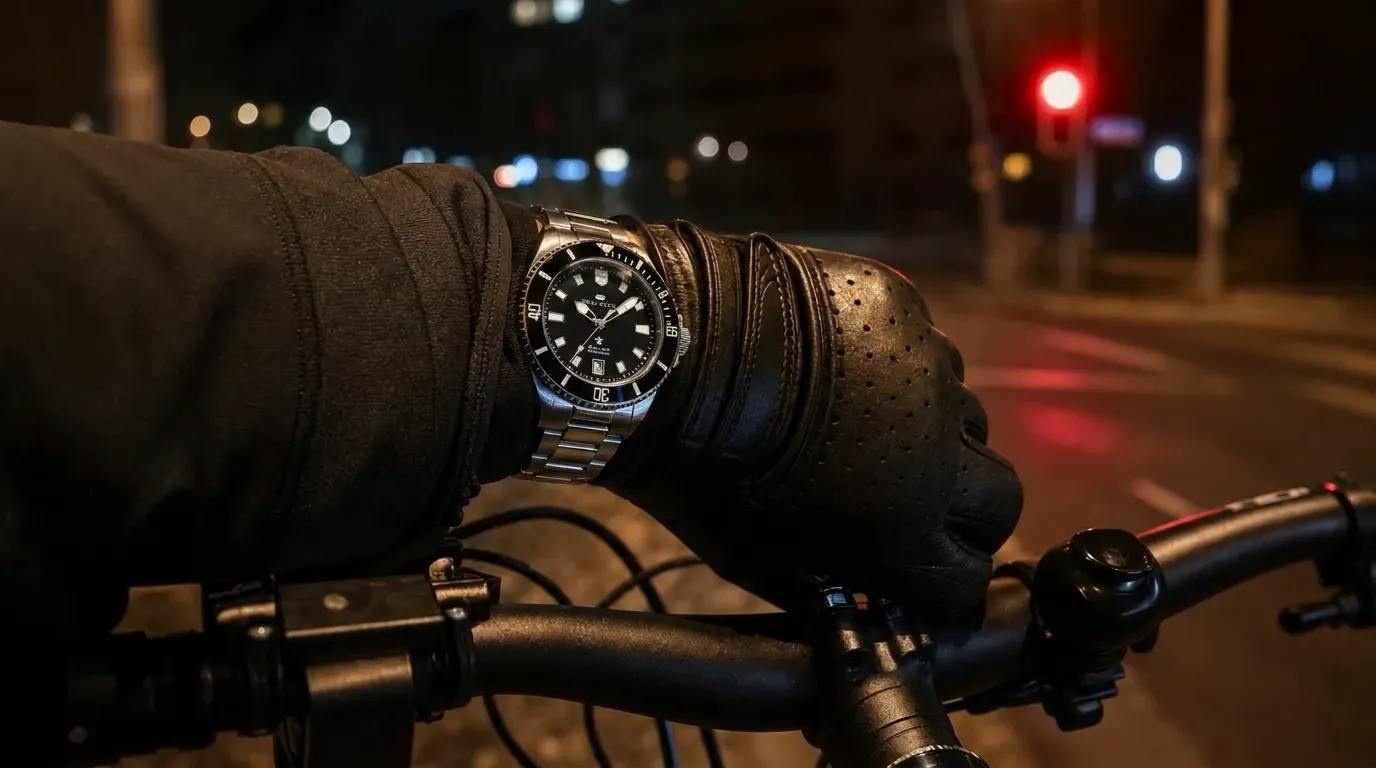
- Glance briefly at the watch dial using ambient street lighting or stored dial photoluminescence.
- Return both hands to the handlebars and scan the intersection before resuming travel.
Night Vision Preservation and Movement Operating Conditions
Scotopic Adaptation vs. Electronic Glare
Our low-light vision relies on the rods in our eyes, adapting to scotopic and mesopic conditions. At a dark intersection, activating a bright, blue-white smartphone screen quickly bleaches retinal photopigments and constricts pupils. This degrades peripheral hazard detection once attention returns to the road. Reading a non-backlit watch dial while stopped avoids electronic glare and reserves handlebar space for essential headlights.
Movement Selection and Maintenance Rules
Choosing between quartz and mechanical watches is a matter of operational preference, as neither movement type is universally superior.
- Quartz Movements: Operate via battery power and a quartz crystal oscillator, maintaining continuous timekeeping when left unworn for extended periods.
- Automatic Mechanical Movements: Wind the mainspring through an oscillating rotor driven by normal wrist motion. If left unworn beyond the power reserve, the movement stops and requires winding, time resetting, and calendar adjustment prior to the commute.
- Manual-Wind Mechanical Movements: Require periodic hand-winding via the crown to tension the mainspring.
- Shock Protection: Wear mechanical watches on the wrist so the arm and shoulder joints absorb road shock; do not attach a mechanical watch directly to an unpadded rigid handlebar mount.
Water-Resistance Precautions for Wet Commutes
A watch's stated water resistance, such as 20 bar / 200 m or 30 bar / 300 m, indicates a laboratory pressure rating when its gaskets are new and intact. This is not a permanent guarantee, as seals naturally degrade over time due to temperature fluctuations, perspiration, and wear.
- Push or screw down the crown completely before riding in rain or road spray.
- Never pull or rotate the crown while the case is wet.
- Avoid leather straps in wet weather; use stainless steel, rubber, or silicone straps during rainy seasons.
Verified Sea-Gull Ocean Series Models for Stopped Time Checks
For watch enthusiasts considering entry-level mechanical watches with dive-style legibility, the following three Ocean Series models offer luminous features, calendar displays, and automatic winding.
| Model Reference | Case Diameter & Thickness | Movement Type | Rated Water Resistance | Confirmed Case, Bezel, Crystal & Strap Details |
|---|---|---|---|---|
Ocean Series 1219 (816.22.1219 / 816.32.1219 / 816.92.1219) |
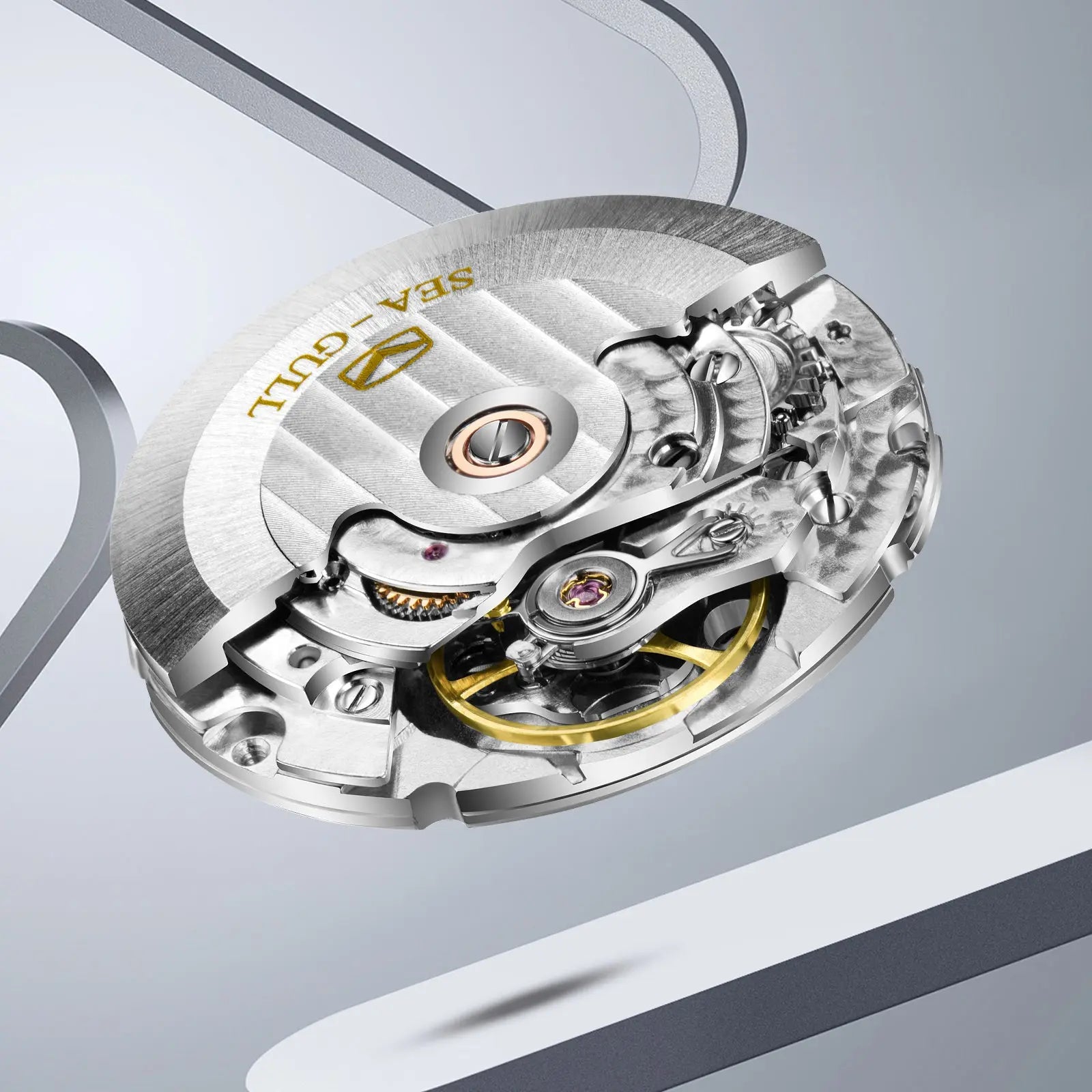
39 mm diameter; 12.6 mm thickness | Sea-Gull ST2130 automatic (28 jewels, 28,800 vph) | 20 bar / 200 m | 316L stainless steel case, synthetic sapphire crystal, metallic gradient dial, calendar, luminous feature, dual-strap versatility including rubber strap (approx. 19 cm length, 20 mm width) |
Ocean Series PRO 1213 (816.22.1213 / 816.32.1213 / 816.92.1213) |
41 mm diameter | Sea-Gull ST2130 automatic | 30 bar / 300 m | 316L stainless steel case, sapphire bezel, dive layout with calendar, luminous feature |
Ocean Series 6204 (814.37.6204 / 816.37.6204 / 816.57.6204) |
40 mm diameter | Automatic mechanical movement | 20 bar / 200 m | Entry-level dive layout with calendar, luminous feature, silicone strap configuration |
Compact 39mm Profile: Ocean Series 1219
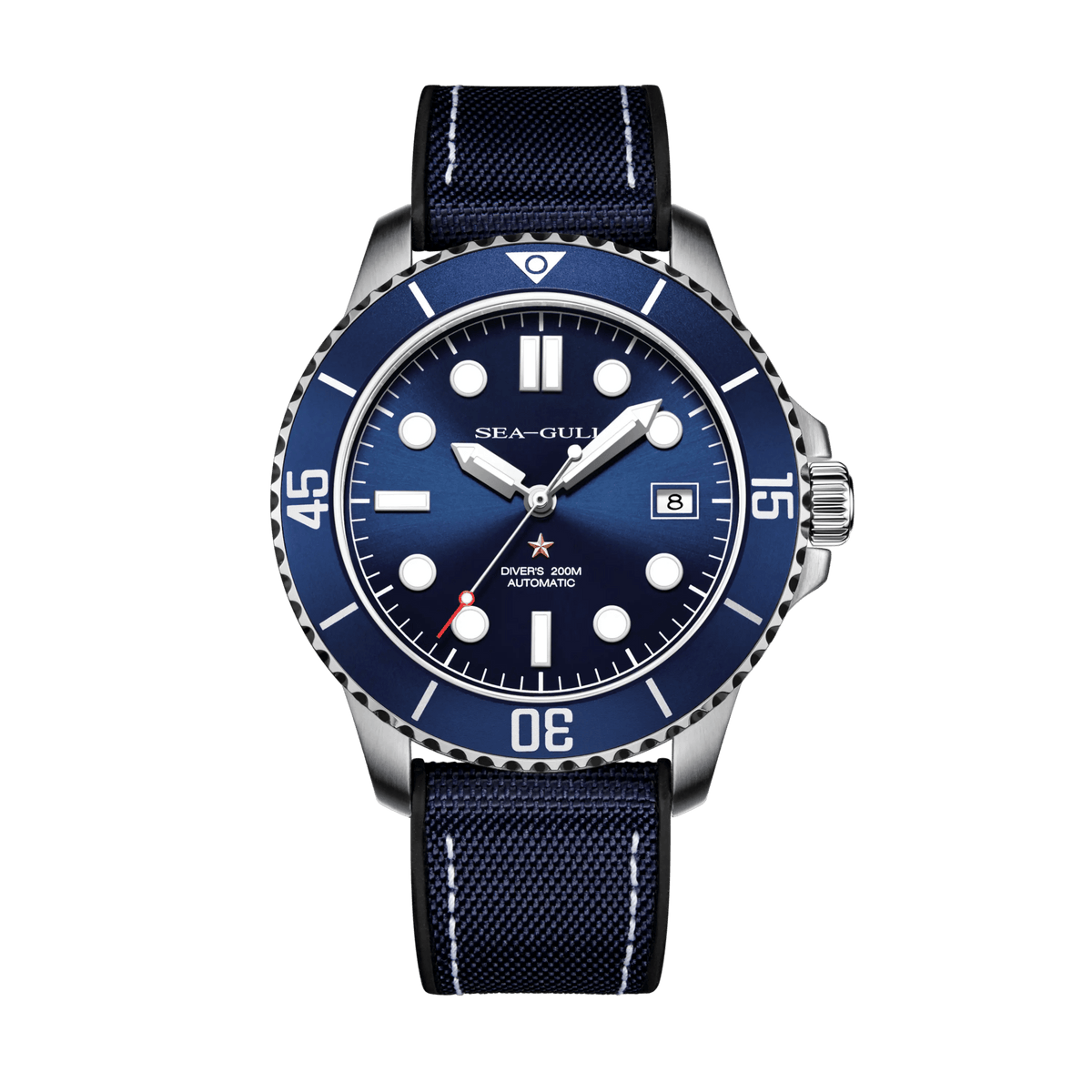
The Ocean Series Gradient Dial Dive Watch 1219 features a 39 mm, 316L stainless steel case measuring 12.6 mm thick, designed to fit comfortably under winter cycling jacket cuffs. It is powered by the Sea-Gull ST2130 automatic movement, which operates at 28,800 vph (4 Hz) with 28 jewels. This model includes a synthetic sapphire crystal, a metallic gradient dial with a calendar, and a luminous feature. It offers a 20 bar / 200 m water-resistance rating and comes with a 20 mm rubber strap option.

Higher-Rated 41mm Architecture: Ocean Series PRO 1213
The Ocean Series PRO 300M Dive Watch 1213 features a 41 mm 316L stainless steel case with a water resistance rating of 30 bar / 300 m, provided seals are maintained. It is powered by the Sea-Gull ST2130 automatic movement and includes a sapphire bezel, a calendar display, and a luminous feature for checking the time while stopped.

Silicone-Strap 40mm Configuration: Ocean Series 6204
The Ocean Series Entry-Level 200M Dive Watch 6204 features a 40 mm case, an automatic mechanical movement, a 20 bar / 200 m water-resistance rating, a calendar function, and a luminous display. Its silicone strap variant is suitable for wet conditions, resisting moisture and perspiration.



Leave a comment
This site is protected by hCaptcha and the hCaptcha Privacy Policy and Terms of Service apply.